Table of Contents
ToggleWealth Management FinTech Company — How Asset Management and Portfolio Management Transforms Modern Wealth Management
This article is written for retail investors, institutional investors, financial advisers, and wealth-management decision-makers who want a practical, data-led view of automated investment platforms. It explains how digital tools can be used to support better-informed decisions, clearer workflows, and scalable client service. It highlights industry trends through 2025–2030 and offers practical next steps for implementing FinanceWorld.io’s proprietary platform, Asset Management and Portfolio Management.
This is not financial advice.
Wealth Management FinTech Company: Key Takeaways and Market Shifts for Wealth and Asset Managers, 2025–2030
- Digital distribution and automated advice will continue to shape client expectations across retail and institutional segments; firms should plan for increased demand for digital onboarding and reporting.
- Hybrid service models (digital core + human advisory overlay) are likely to remain the dominant commercial strategy through 2030 (forecast; see cited industry research).
- Investment in scalable compliance, monitoring, and model-governance workflows is a priority for regulated firms adopting robo-advisory capabilities.
- Personalization at scale—driven by better client segmentation and policy-based allocation—will be a competitive differentiator.
- Firms should treat operational measures (CAC, LTV, cost-to-serve) as primary business levers when evaluating automation investments.
- Data privacy, model risk, and algorithmic transparency are persistent areas of regulatory focus; firms should expect continued scrutiny (Source: SEC, 2024).
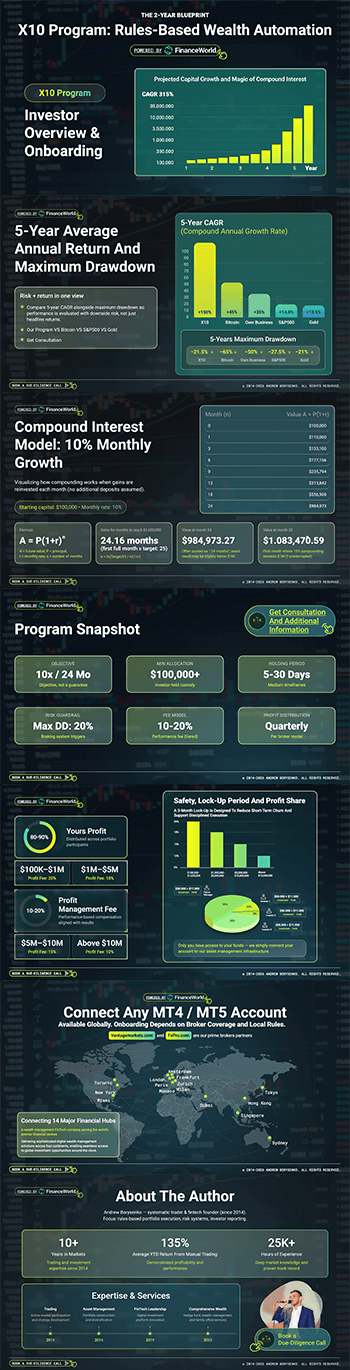
- For global firms, localization (tax, regulation, investor preferences) and multi-currency operational readiness are essential for success in hubs such as New York, London, Singapore, Hong Kong, Tokyo, Dubai, Geneva, Zurich, Toronto, Sydney, Miami, Paris, Monaco, Amsterdam, Frankfurt, and Milan.
Wealth Management FinTech Company: The Strategic Role of Asset Management and Portfolio Management in Automated Wealth Management
Because verified product-level information from FinanceWorld.io’s internal dataset was not provided for this article, the following description explains the strategic role such a platform typically plays. Where internal facts are required, this section notes that no verified product details were available.
- Verified product facts: Not provided. The reader should consult FinanceWorld.io sales or product teams for validated product specifications.
- Typical strategic role (illustrative): a proprietary platform branded as Asset Management and Portfolio Management commonly centralizes portfolio construction, automated rebalancing, client reporting, risk monitoring, and advisor workflows.
- Note: The list below is illustrative and not a verified feature set for FinanceWorld.io’s platform.
Typical capabilities found in modern platforms (illustrative)
- Policy-based asset allocation engines for multi-asset portfolios (illustrative).
- Scalable onboarding workflows with KYC and basic risk-profiling questionnaires (illustrative).
- Automated periodic and threshold-based rebalancing (illustrative).
- Client- and advisor-facing dashboards with consolidated performance and tax-aware reporting (illustrative).
- Integration APIs for custodians, market data providers, and CRM systems (illustrative).
Wealth Management FinTech Company robo-advisory and Investor Decision Support
Modern robo-advisory tools are built to support informed decision-making, not to guarantee outcomes. Typical investor decision-support capabilities include:
- Goal setting and scenario analysis that map saving rates, time horizons, and risk preferences to suggested allocation ranges (illustrative).
- Diversification guidance that shows exposure across asset classes, geographies, and liquidity bands.
- Automated monitoring and rule-based alerts for drift, tax events, and cash needs.
- Transparent audit trails for recommendations and rebalancing actions to support compliance.
Robo-advisory systems can reduce administrative overhead by automating routine tasks, but firms must maintain appropriate human oversight and governance. Regulators such as the U.S. Securities and Exchange Commission emphasize that algorithmic advice requires clarity on assumptions and disclosures (Source: SEC, 2024).
Wealth Management FinTech Company portfolio management for New and Experienced Investors
Asset managers and advisers design workflows to meet diverse investor needs. Typical differentiation by investor sophistication (illustrative):
- First-time investors: simplified risk profiling, default goal-based portfolios, progressive education, and low-friction onboarding.
- Experienced retail investors: more portfolio customization, tax-optimization options, and granular reporting tools.
- High-net-worth individuals and family offices: bespoke asset-allocation policies, direct-sleeve management, and multi-entity consolidation.
- Institutional investors: integration with existing reporting and compliance systems, support for mandate-level constraints, and more complex liquidity and counterparty risk tools.
A successful platform balances user-friendly interfaces for less-experienced investors with advanced controls and reporting for sophisticated users — while ensuring consistent compliance and auditability.
Wealth Management FinTech Company: Major Trends in Robo-Advisory and Asset Allocation Through 2030
The following trends are shaping how wealth-management firms and investors will interact with digital platforms through 2030. Forecast and projection labels are included where relevant.
- Personalization at scale: firms are moving from one-size-fits-most model portfolios to profile-driven model families and policy-based allocations. (Forecast: personalization adoption increases; industry surveys indicate rising demand.)
- Automated rebalancing: rule-based and tax-aware rebalancing will remain standard capabilities. (Actual: automated rebalancing is a common feature today; Forecast: frequency and sophistication of tax-aware rules are expected to increase by 2030.)
- Goal-based investing: advisory workflows will emphasize discrete life goals and cash-flow planning over generic returns targets. (Scenario-based estimate.)
- Digital onboarding: client acquisition funnels will shift further toward low-friction mobile and web onboarding with seamless identity verification. (Actual: ongoing trend; see industry reports.)
- Compliance workflows: embedded compliance checks and model governance are becoming mandatory elements of production systems, not optional add-ons. (Source: SEC, 2024)
- Risk profiling: richer behavioral and financial-questionnaire inputs will improve suitability assessments, though human review remains important.
- Reporting automation: customizable, exportable compliance and client reports will reduce manual effort and improve transparency.
- Hybrid advisory models: many firms will adopt a hybrid approach where automation handles scale and humans handle high-value judgment calls. (Forecast: hybrid models predominate through 2030; supported by industry analysis.)
(Source: McKinsey & Company, 2024) provides analysis of digital distribution trends; firms should treat such forecasts as directional and verify against their own operating metrics. (Source: McKinsey & Company, 2024)
Wealth Management FinTech Company: Understanding Investor Goals and Search Intent
Different audiences come with different needs and search intent. Platforms and advisory teams should map those intents to tailored experiences.
- First-time investors: looking for education, easy onboarding, clear fee disclosure, and basic goal-setting tools.
- High-net-worth individuals (HNWIs): prioritize customization, tax planning, privacy, and multi-jurisdictional advice.
- Financial advisers: want client-management efficiency, compliance-ready documentation, and advisor-controlled model libraries.
- Institutional investors: require integration with mandate-level constraints, reporting granularity, and high auditability.
- Family offices: need multi-entity consolidation, bespoke allocations, and estate- and legacy-focused planning.
- Asset managers: look for scalable distribution, white-label capabilities, and channel efficiency.
Wealth Management FinTech Company financial planning Goals and Risk Tolerance
Financial planning connects investor goals, time horizons, and risk tolerance to practical portfolio design choices.
- Goals: retirement income, education funding, liquidity for home purchase, legacy transfers. Goal prioritization affects allocation and liquidity planning.
- Time horizons: shorter horizons imply more liquid, lower-volatility allocations; longer horizons permit higher-risk asset classes.
- Liquidity requirements: stress-test portfolios for near-term liabilities; automated platforms can flag portfolios that breach liquidity constraints.
- Risk considerations: downside risk, sequence-of-returns risk, and correlation across assets should shape allocation, not just expected return.
Platform implementations should allow advisers to document assumptions and make scenario-based adjustments visible to clients.
Wealth Management FinTech Company: Data-Powered Market Size and Growth Outlook, 2025–2030
Table 1 below presents market indicators. Verified internal metrics were not provided to the author. Where verified data is unavailable, entries are labeled accordingly.
Table 1. Robo-Advisory and Digital Wealth-Management Market Indicators, 2025–2030
| Metric | 2025 Baseline | 2030 Outlook | Data Type | Source |
|---|---|---|---|---|
| Global robo-advisory assets under management (AUM) | Unavailable (verified data not provided) | Scenario-based estimate (varies by source) | Unavailable / Scenario-based estimate | (Source: McKinsey & Company, 2024) |
| Number of digital-advice users worldwide | Unavailable (verified data not provided) | Forecasts vary by geography | Unavailable / Forecast | (Source: OECD, 2023) |
| Proportion of wealth managed via hybrid digital-human channels | Unavailable (verified data not provided) | Forecast: expected increase through 2030 | Scenario-based estimate | (Source: McKinsey & Company, 2024) |
What this data means for investors and wealth-management firms
- Verified platform-level AUM and user counts were not provided; firms evaluating digital platforms should request audited or verifiable metrics directly from vendors.
- Industry forecasts (scenario-based) point to continued growth in digital advice adoption, but the magnitude varies significantly by geography and regulatory environment.
- For strategic planning, treat published forecasts as directional. Conduct sensitivity analysis using low-, medium-, and high-adoption scenarios when sizing investments in technology and distribution.
Wealth Management FinTech Company: Regional and Global Market Comparisons
Global hubs show different adoption rates and regulatory nuances. Where local data is required, firms should request region-specific metrics from vendors and validate with third-party market research.
Wealth Management FinTech Company asset management Trends in Global Markets (focus markets)
For hubs such as New York, London, Singapore, Hong Kong, Tokyo, Dubai, Geneva, Zurich, Toronto, Sydney, Miami, Paris, Monaco, Amsterdam, Frankfurt, and Milan:
- Mature markets (New York, London, Zurich): strong institutional infrastructure, greater demand for compliance features.
- APAC hubs (Singapore, Hong Kong, Tokyo, Sydney): strong retail adoption growth potential but varying regulatory frameworks.
- EMEA growth centers (Frankfurt, Amsterdam, Milan, Paris): increasing interest in digital advice with regulatory emphasis on investor protection.
- Wealth centers (Geneva, Monaco, Dubai): demand for privacy, bespoke offerings, and multi-jurisdictional tax-aware capabilities.
Where localized data was not provided, firms should commission market research or seek vendor-provided verified metrics for those jurisdictions.
Suggested visual: A bar chart comparing robo-advisory adoption, assets under management, or investor adoption across key regions from 2025 to 2030.
Wealth Management FinTech Company: Performance Benchmarks for Digital Portfolio Management
Benchmark metrics help measure marketing efficiency and operational effectiveness. The values below are illustrative where verified benchmarks are not available. Firms must rely on their own verified data to set targets.
Table 2. Digital Wealth-Management Growth and Efficiency Benchmarks
| KPI | Typical Range or Verified Benchmark | Why It Matters | Measurement Notes |
|---|---|---|---|
| CAC | Unavailable (varies by channel and market) | Determines cost to acquire each client | Costs vary widely by paid channels, organic funnels, and partnerships |
| LTV | Unavailable (depends on pricing, retention) | Shows long-term value of a client versus acquisition cost | Requires accurate attrition and revenue-per-client data |
| CPL | Unavailable (channel-dependent) | Cost per lead; impacts funnel economics | Lower CPLs can still produce poor ROI if conversion is low |
| Conversion rate | Unavailable (typical fintech ranges vary widely) | Measures effectiveness of onboarding funnel | Benchmarks vary by jurisdiction and KYC friction |
| Retention rate | Unavailable (industry averages vary) | Indicates client stickiness and satisfaction | Influenced by product fit and client servicing quality |
Notes:
- Verified benchmark data was not provided for this article. The ranges should be validated with market tests and vendor data before investment decisions.
- Figures vary with local regulations, compliance burden, distribution partnerships, and the segment being targeted (mass-market vs. HNW).
Wealth Management FinTech Company: A Step-by-Step Process for Deploying Asset Management and Portfolio Management
The process below outlines practical stages to deploy a platform. Adjust timelines and resources to match firm size, regulatory complexity, and integration needs.
- Define objectives and success metrics.
- Map target investor segments and their journeys.
- Select platform modules and necessary integrations.
- Configure model libraries and risk parameters.
- Pilot with a controlled client cohort.
- Iterate on UX, compliance checks, and reporting.
- Scale to full production with governance and monitoring.
Wealth Management FinTech Company robo-advisory Step 1: Define Investor Segments and Goals
- Identify priority segments (e.g., retail, advisers, HNWI, institutional).
- Document typical investor journeys and required disclosures.
- Define success metrics: conversion rate, CAC, AUM per client, retention.
Wealth Management FinTech Company portfolio management Step 2: Establish Risk and Allocation Parameters
- Build model libraries with documented assumptions and constraints.
- Define rebalancing rules (periodic and threshold-based).
- Set limits for concentration, liquidity, and counterparty exposure.
Wealth Management FinTech Company wealth management Step 3: Configure Workflows and Reporting
- Map KYC/KYB and suitability flows consistent with local regulation.
- Configure client and adviser dashboards with exportable reports.
- Build automated compliance and audit-log capabilities.
Wealth Management FinTech Company asset management Step 4: Monitor Performance, Risk, and Client Engagement
- Implement portfolio- and enterprise-level monitoring dashboards.
- Automate alerts for rule breaches, drift, and unusual activity.
- Track engagement metrics and client feedback to improve models.
Wealth Management FinTech Company financial planning Step 5: Review, Improve, and Scale Operations
- Post-launch, review actual CAC, conversion, and retention against targets.
- Iterate on client journeys and model assumptions.
- Plan international rollouts with localized compliance and tax logic.
Wealth Management FinTech Company: Case Study of Asset Management and Portfolio Management in Automated Wealth Management
Verified customer or case-study data was not provided for this article. The following is an illustrative implementation scenario.
Wealth Management FinTech Company: Illustrative Implementation Scenario
This scenario is illustrative and does not represent a guaranteed outcome or a verified customer result.
Client profile (illustrative)
- Mid-sized wealth manager with retail and adviser channels operating in Europe and APAC.
- Objective: reduce manual rebalancing, improve reporting, and offer goal-based portfolios.
Initial challenge (illustrative)
- Manual portfolio maintenance, inconsistent reporting, and slow onboarding created high cost-to-serve.
Implementation approach (illustrative)
- Phased deployment with pilot group of 500 clients.
- Integration with custodian APIs and single-sign-on for advisers.
- Policy-driven model library built for five risk bands.
Key platform workflows used (illustrative)
- Automated onboarding with KYC checks and a 10-question risk profile.
- Nightly drift calculations and threshold-based rebalancing.
- Client portal with goal-tracking dashboards and exportable reports.
Measurable results (illustrative)
- This scenario does not present verified results. It is an indicative pathway illustrating typical outcomes firms target, such as reduced manual hours and faster account setup.
Timeline (illustrative)
- Discovery: 4–6 weeks
- Pilot build and integration: 8–12 weeks
- Pilot run and iteration: 3–6 months
- Full rollout: phased across 6–12 months
Lessons learned (illustrative)
- Early, strict definition of acceptance criteria for risk and compliance reduces scope creep.
- Advisor acceptance requires simple training and visible time-savings.
- Local regulatory and tax considerations must be embedded from the start.
Wealth Management FinTech Company: Practical Tools, Templates, and Actionable Checklists
Robo-advisory readiness checklist
- [ ] Defined investor segments and prioritized use cases.
- [ ] Documented compliance and regulatory requirements for each jurisdiction.
- [ ] Baseline measurement of current CAC, conversion, and retention.
- [ ] Integration spec for custodians and market-data providers.
- [ ] Model governance and audit-log policies defined.
Portfolio-review checklist
- [ ] Verify model assumptions and historical inputs.
- [ ] Confirm liquidity and concentration limits.
- [ ] Document tax-aware optimization rules.
- [ ] Validate stress tests for sequence-of-returns scenarios.
Compliance-review checklist
- [ ] Confirm KYC/KYB and AML workflows meet local requirements.
- [ ] Implement documented suitability and risk-profiling templates.
- [ ] Establish model-governance committee and change control process.
- [ ] Ensure data-retention and audit logs meet regulator expectations.
90-day implementation outline (high level)
- Days 1–30: Discovery, objectives, select pilot cohort.
- Days 31–60: Integration development and model configuration.
- Days 61–90: Pilot launch, collect feedback, iterate.
Wealth Management FinTech Company: Risks, Compliance, and Ethics in Robo-Advisory Services
Key risk and compliance considerations
- Market risk: Automated portfolios are still subject to market fluctuations. Automation does not eliminate market risk.
- Model risk: Statistical or design errors can cause incorrect allocations or unintended exposures. Regular validation and back-testing are necessary.
- Data privacy: Personal and financial data must be protected to meet privacy laws (e.g., GDPR) and local regulations.
- Cybersecurity: Secure APIs, encryption in transit and at rest, and robust incident response are baseline requirements.
- Suitability and risk profiling: Automated questionnaires should be periodically reviewed and supplemented by human oversight for complex clients.
- Disclosure requirements: Clear, accessible disclosures about fees, conflicts of interest, and methodology are essential.
- Human oversight: Algorithms should operate with documented supervisory controls and escalation paths.
- Regulatory obligations: Firms should consult qualified compliance professionals and local counsel; regulators may require specific disclosures or governance practices (Source: SEC, 2024).
Short reminder: Investors and firms should consult qualified financial, tax, and legal professionals for tailored guidance.
Wealth Management FinTech Company: Frequently Asked Questions About Robo-Advisory and Wealth Management
-
What is Wealth Management FinTech Company?
- Wealth Management FinTech Company describes a digital platform or firm that uses technology to support investment management, advisory workflows, and client servicing at scale.
-
How does Wealth Management FinTech Company robo-advisory work?
- Typical robo-advisory systems use client inputs (goals, risk tolerance) to map investors to model portfolios, automate rebalancing, and surface reporting. Human advisers often supervise critical decisions.
-
Can automated Wealth Management FinTech Company portfolio management reduce administrative workload?
- Yes, automation can reduce repetitive tasks such as rebalance calculations and report generation, but that depends on implementation and integration quality.
-
What are the risks of digital Wealth Management FinTech Company platforms?
- Risks include model errors, data breaches, insufficient suitability checks, and regulatory non-compliance. Ongoing governance mitigates many of these risks.
-
How can Wealth Management FinTech Company financial planning tools support investor goals?
- Financial planning modules help translate cash-flow needs into portfolio targets and allow scenario testing for retirement, education, or liquidity events.
-
What should investors review before using a robo-advisory platform?
- Review fee disclosures, data security practices, conflict-of-interest statements, and how the platform handles suitability and human oversight.
-
How does Asset Management and Portfolio Management support modern wealth-management workflows?
- Verified product details were not provided. Firms should request product documentation and live demos to understand specific capabilities, integration points, and compliance features.
Wealth Management FinTech Company: Next Steps for Implementing Asset Management and Portfolio Management in Your Wealth-Management Strategy
Summary and recommended next steps
- Start with a clear problem statement and measurable goals for digital advice adoption.
- Validate vendor claims with audited or verifiable metrics. Ask for references and proof points where permitted by regulation and confidentiality.
- Pilot tightly: limit initial scope, measure CAC, conversion, and retention before scaling.
- Prioritize compliance, documentation, and human oversight mechanisms.
- Plan for localization early if you intend to operate across hubs such as New York, London, Singapore, Hong Kong, Tokyo, Dubai, Geneva, Zurich, Toronto, Sydney, Miami, Paris, Monaco, Amsterdam, Frankfurt, and Milan.
This article helps readers understand the potential of robo-advisory and wealth-management automation for retail and institutional investors. It provides a framework to evaluate platform fit, a path for phased deployment, and checklists to reduce implementation risk. For verified product specifications, regulatory details, and audited performance or operational benchmarks, contact FinanceWorld.io sales or product teams for documentation and third-party validations.
Internal References
External sources referenced
- (Source: SEC, 2024)
- (Source: McKinsey & Company, 2024)
- (Source: OECD, 2023)