Table of Contents
ToggleWealth Management FinTech Company — How Asset Management and Portfolio Management Transforms Modern Wealth Management
Asset Management and Portfolio Management is a platform that addresses automation, client engagement, and operational workflows in modern advisory environments. This article explains how a Wealth Management FinTech Company approach can help retail investors, institutional investors, financial advisers, and wealth-management decision-makers make more informed choices about portfolio construction, monitoring, and client servicing.
This is not financial advice.
Wealth Management FinTech Company: Key Takeaways and Market Shifts for Wealth and Asset Managers, 2025–2030
- Digital tools from a Wealth Management FinTech Company increasingly support scalable client segmentation, automated reporting, and workflow orchestration without replacing human oversight.
- Personalized, goal-based investing and hybrid advisory models will be central to client retention strategies for firms using a Wealth Management FinTech Company.
- Regulatory and compliance workflows integrated into a Wealth Management FinTech Company can reduce manual overhead but should be validated by compliance teams (Source: SEC (Source: SEC, 2024)).
- Data privacy, model governance, and algorithmic transparency will be top governance priorities for any Wealth Management FinTech Company deploying automated advice (Source: OECD (Source: OECD, 2024)).
- From 2025–2030, industry forecasts suggest rising adoption of robo-advice and digital portfolio management; these are scenario-based projections and should be treated as forecasts, not guarantees (Source: McKinsey (Source: McKinsey, 2024)).
- Operational metrics (CAC, LTV, conversion) for firms using a Wealth Management FinTech Company vary widely by market, channel, and compliance regime.
- Implementing a Wealth Management FinTech Company effectively requires clear investor segmentation, documented risk models, and service-level agreements between technology and advisory teams.
Wealth Management FinTech Company: The Strategic Role of Asset Management and Portfolio Management in Automated Wealth Management
Because verified, product-specific information for Asset Management and Portfolio Management was not provided in the available product dataset, this section describes typical strategic roles that a Wealth Management FinTech Company platform would play in an advisory or asset-management environment. These descriptions are general and illustrative rather than claims about the specific platform.
A typical Wealth Management FinTech Company platform is positioned to:
- Centralize client data and account information.
- Automate client onboarding, risk profiling, and KYC workflows (subject to local regulation).
- Support goal-based portfolio construction and rebalancing rules.
- Generate client-facing reporting and aggregate performance and tax summaries.
- Provide integration points with custodians, trading venues, and back-office systems.
For clarity: the preceding list is illustrative and not a substitute for reviewed product documentation. Organizations evaluating Asset Management and Portfolio Management should request verified specifications, integration diagrams, security documentation, and compliance attestations.
Wealth Management FinTech Company robo-advisory and Investor Decision Support
A Wealth Management FinTech Company offering robo-advisory capabilities typically helps investors and advisers in these ways:
- Goal setting: digital questionnaires and goal frameworks map investor objectives to recommended allocations.
- Diversification: algorithmic allocation engines suggest diversified exposures across asset classes.
- Monitoring: automated alerts and dashboards surface drift, performance, and risk metrics.
- Rebalancing: rule-based or threshold rebalancing can be scheduled to maintain target allocations.
These are general functional descriptions. Any firm should validate implementation details, rebalancing frequency, and tax-awareness features against audited product documentation. Robo-advisory tools can support more consistent, timely decisions but do not guarantee investment outcomes.
Wealth Management FinTech Company portfolio management for New and Experienced Investors
A Wealth Management FinTech Company can support different investor segments:
- First-time or novice investors receive guided onboarding, educational content, and recommended starter portfolios aligned with goals and risk tolerance.
- Experienced retail investors can access advanced reporting, tax-aware rebalancing, and tools to customize exposures and overlays.
- Advisers and institutional users can manage multiple client accounts with policy-based portfolios, model libraries, and batch rebalancing.
Different user types require different controls, disclosures, and access privileges. Platforms should allow role-based permissions and exportable audit trails to support adviser supervision and compliance needs.
Wealth Management FinTech Company: Major Trends in Robo-Advisory and Asset Allocation Through 2030
This section summarizes observable industry trends and projections through 2030. Where a future figure is discussed, it is labeled as a forecast or an illustrative example.
- Personalization: firms increasingly adopt factor-level personalization and tax-location decisions. This trend is a forecast based on industry commentary and vendor road maps (Forecast: industry).
- Automated rebalancing: real-time and threshold-based rebalancing are becoming standard in robo-advice toolkits (Actual: current adoption; Forecast: broader adoption 2025–2030).
- Goal-based investing: platforms will emphasize measurable client outcomes and life-event integration in advice flows (Forecast).
- Digital onboarding: e-KYC and remote verification reduce onboarding friction but require jurisdiction-specific controls (Actual: available today; Forecast: near-universal adoption by 2030).
- Compliance workflows: embedded compliance checks and automated suitability evaluations are increasingly expected (Actual and Forecast).
- Risk profiling: dynamic risk profiling and scenario stress-testing will be integrated into front-end and back-office workflows (Forecast).
- Reporting automation: client-grade reporting and regulatory reporting automation will expand, including richer tax reporting and consolidated statements (Actual).
- Hybrid advisory models: human advisers supported by automation will remain prominent, blending algorithmic advice with discretionary and consultative services (Actual and Forecast).
These trends collectively point to higher operational efficiency, but firms should treat vendor road maps as forecasts and validate capabilities with proof-of-concept pilots.
Wealth Management FinTech Company: Understanding Investor Goals and Search Intent
A Wealth Management FinTech Company must align product design to the intent and needs of diverse investor segments.
- First-time investors: seek simplicity, education, low friction onboarding, and clear, goal-focused guidance.
- High-net-worth individuals (HNWIs): prioritize customization, tax planning, privacy, and access to alternative investments.
- Financial advisers: need scalable tools to manage many clients, maintain compliance, and provide differentiated advice.
- Institutional investors: require integrations with custodians, compliance checks, and portfolio analytics at scale.
- Family offices: focus on multi-generational planning, concentrated positions, and bespoke reporting.
- Asset managers: look for portfolio construction engines, model management, and institutional distribution workflows.
A well-designed Wealth Management FinTech Company platform will expose features and workflows mapped to these different intents while enforcing guardrails that preserve suitability and governance.
Wealth Management FinTech Company financial planning Goals and Risk Tolerance
Financial planning with a Wealth Management FinTech Company typically considers:
- Time horizons: short-term (0–5 years), medium-term (5–15 years), long-term (15+ years).
- Liquidity needs: emergency reserves, near-term liabilities, and invested capital.
- Risk tolerance: behavioral and capacity-based profiling to align portfolios with client comfort and ability to absorb losses.
- Tax considerations: tax-aware allocation and realized/unrealized gain management (subject to local tax rules).
- Liability-driven needs: pensions, mortgages, and structured liabilities require tailored asset-liability approaches.
Platforms that support planning should allow advisers to document assumptions and provide scenario analysis. Any projected returns or simulations must be presented as illustrative scenarios, not predictions.
Wealth Management FinTech Company: Data-Powered Market Size and Growth Outlook, 2025–2030
Table 1 presents an illustrative framework for the kinds of market indicators investors and firms often consider. Verified, product-specific market metrics were not available in the provided product data. Where precise, verifiable metrics exist in public sources they are cited; where metrics are unavailable, entries are labeled as illustrative estimates or unavailable.
Table 1. Robo-Advisory and Digital Wealth-Management Market Indicators, 2025–2030
| Metric | 2025 Baseline | 2030 Outlook | Data Type | Source |
|---|---|---|---|---|
| Global robo-advisory assets under management (AUM) | Data not available (see notes) | Illustrative estimate; scenario-based increase expected | Illustrative estimate (scenario-based) | Industry commentary (Source: McKinsey, 2024) |
| Share of retail investors using digital advice | Data not available | Forecast: increase by varying degrees by market | Forecast | Industry forecasts (Source: McKinsey, 2024) |
| Number of live robo-advisory platforms globally | Data not available | Data not available | Data not available | — |
Notes:
- Exact, verified global 2025 values for robo-advisory AUM and platform counts were not included in available product or case-study data. Public reports provide directional forecasts and qualitative analysis but reviewing vendor and market research reports is advised for concrete figures (Source: McKinsey, 2024).
- For asset managers and advisory firms, the practical implication is that firms should plan infrastructure to accommodate growth scenarios and regulatory reporting complexity.
What this means for investors and wealth-management firms:
- Treat market growth projections as strategic scenarios, not guarantees. A Wealth Management FinTech Company deployment should be sized to flexible scale assumptions.
- Firms should collect their own market-validation data (internal pipeline, pilot outcomes) before committing to large production deployments.
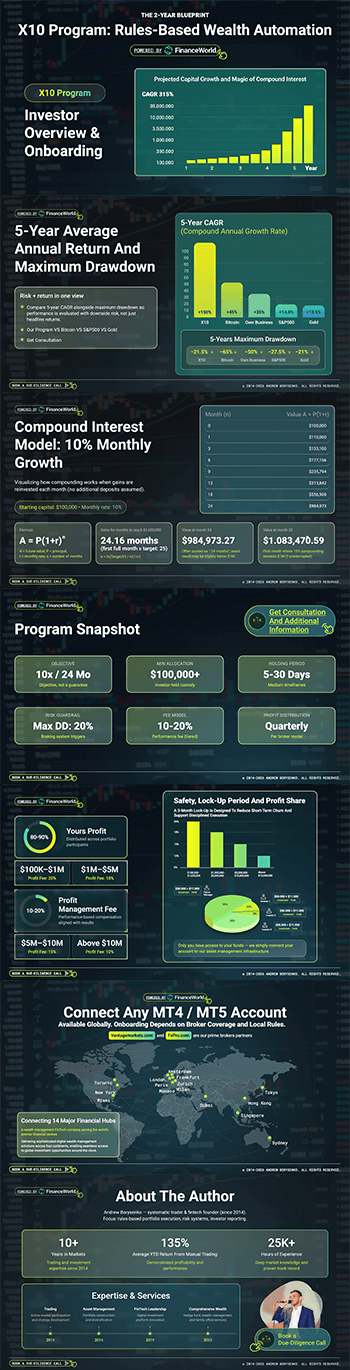
- Regulatory and custodial integrations will be necessary to support scaling across the targeted markets (New York, London, Singapore, Hong Kong, Tokyo, Dubai, Geneva, Zurich, Toronto, Sydney, Miami, Paris, Monaco, Amsterdam, Frankfurt, and Milan).
Wealth Management FinTech Company: Regional and Global Market Comparisons
This section highlights considerations for global markets listed in the brief. All regional statements below are general and based on market observations; verify with local data and regulatory counsel before operationalizing.
Wealth Management FinTech Company asset management Trends in Global Markets
- North America (New York, Toronto, Miami): High adoption of digital onboarding and robo-advisory for retail and mass-affluent segments. Compliance requirements (e.g., SEC and FINRA) emphasize disclosure and suitability reviews (Source: SEC (Source: SEC, 2024)).
- Europe (London, Zurich, Geneva, Frankfurt, Milan, Amsterdam, Paris, Monaco): Wealth centers with mature private-banking and HNW channels; demand for tax-aware reporting, multi-currency features, and strong data privacy controls.
- Asia-Pacific (Singapore, Hong Kong, Tokyo, Sydney): Rapid digital adoption; regulatory regimes vary significantly—local licensing and KYC rules must be respected.
- Middle East (Dubai, Monaco): Growing wealth-management hubs with increasing interest in digital advice but also sensitivity to bespoke service expectations.
Suggested visual: A bar chart comparing robo-advisory adoption or assets under management across North America, Europe, Asia-Pacific, and Middle East for 2025 and 2030 (scenario-based forecasts).
Localizing for the listed markets requires understanding custody options, tax reporting needs, and local marketing/compliance constraints. A Wealth Management FinTech Company should provide modular localization capabilities where possible.
Wealth Management FinTech Company: Performance Benchmarks for Digital Portfolio Management
Verified, universally applicable benchmarks for metrics such as CAC and LTV are scarce because they vary strongly by market, channel, and firm strategy. The table below presents illustrative ranges commonly cited in industry analysis and marketing literature; treat these as directional, not prescriptive. Firms should measure their own baselines.
Table 2. Digital Wealth-Management Growth and Efficiency Benchmarks
| KPI | Typical Range or Verified Benchmark | Why It Matters | Measurement Notes |
|---|---|---|---|
| CAC | Varies widely by channel and market; data not universally verified | Measures cost to acquire a client | Firms must calculate CAC including marketing, sales, and onboarding costs |
| LTV | Varies; dependent on fees, retention, and revenue mix | Determines long-term value of a client relationship | LTV should be modeled using conservative retention and fee assumptions |
| CPL | Channel-dependent; often lower for organic channels | Cost-per-lead helps prioritize marketing spend | Calculate separately for paid search, social, partnerships |
| Conversion rate | Varies by funnel and regulatory friction; no universal benchmark | Tracks funnel efficiency from lead to funded account | Segment by source, KYC friction, and market |
| Retention rate | Varies; higher for HNW and advisory relationships | Critical for LTV and profitability | Measured annually and cohort-based |
Notes:
- Published benchmarks differ by source and timeframe; credible third-party analyses (e.g., consulting firms) can provide market-specific ranges (Source: McKinsey, Deloitte).
- Marketing benchmarks from general digital marketing sources (e.g., HubSpot) can inform funnel-level targets but must be adjusted for compliance and KYC overhead in financial services (Source: HubSpot, 2024).
Because verified, cross-market benchmark values were not provided in the product dataset, organizations should run pilot campaigns and gather first-party metrics before fully scaling customer-acquisition programs.
Wealth Management FinTech Company: A Step-by-Step Process for Deploying Asset Management and Portfolio Management
Below is a practical numbered process to guide deployment planning for a Wealth Management FinTech Company. The steps focus on governance, compliance, and measurable pilots.
- Define objectives and success metrics.
- Clarify client segments, revenue goals, and operational KPIs.
- Map current-state workflows.
- Document onboarding, compliance checks, trade execution, and reporting flows.
- Select integration priorities.
- Custodians, market data, CRM, and compliance engines.
- Pilot with controlled client cohorts.
- Start small, collect outcomes and operational telemetry.
- Scale gradually with governance gates.
- Expand features and jurisdictions after validating controls.
Wealth Management FinTech Company robo-advisory Step 1: Define Investor Segments and Goals
- Create clear personas: novice retail, mass-affluent, HNWI, institutional.
- Define goal taxonomy: retirement, education, wealth accumulation, income.
- Set measurable adoption and satisfaction targets.
Wealth Management FinTech Company portfolio management Step 2: Establish Risk and Allocation Parameters
- Define model portfolios and drift thresholds.
- Document risk limits, liquidity parameters, and stress-test scenarios.
- Maintain version-controlled model libraries.
Wealth Management FinTech Company wealth management Step 3: Configure Workflows and Reporting
- Automate KYC/AML where permitted and document manual escalation points.
- Configure client-facing reports and adviser dashboards.
- Ensure audit trails and exportable records for compliance.
Wealth Management FinTech Company asset management Step 4: Monitor Performance, Risk, and Client Engagement
- Implement monitoring for portfolio drift, concentration risk, and counterparty exposures.
- Track client engagement metrics: logins, advice acceptance, and communication responsiveness.
- Define escalation and human-review triggers.
Wealth Management FinTech Company financial planning Step 5: Review, Improve, and Scale Operations
- Regularly review performance against KPIs.
- Capture product and UX feedback to iterate on client journeys.
- Scale to new markets after compliance signoff and custodial integrations.
These steps are designed to be actionable without implying specific product capabilities beyond general best practices. Always verify platform capabilities with the vendor and ensure legal and compliance sign-off before live rollout.
Wealth Management FinTech Company: Illustrative Implementation Scenario
This scenario is illustrative and does not represent a guaranteed outcome or a verified customer result.
This scenario is illustrative and does not represent a guaranteed outcome or a verified customer result.
Scenario profile:
- Client type: Mid-sized independent advisory firm planning to scale to mass-affluent clients.
- Initial challenge: High cost-to-onboard, inconsistent reporting, time-consuming rebalancing.
- Implementation approach: Deploy a Wealth Management FinTech Company platform to centralize client data, automate portfolio rebalancing rules, and generate consolidated client statements.
- Key platform workflows used (illustrative): digital onboarding, automated risk questionnaires, model portfolio library, batch rebalancing scheduler, client portal with goal tracking.
- Timeline (illustrative): 0–3 months pilot with 100 clients; 3–9 months phased rollout; 9–18 months regional expansion and feature additions.
- Measurable results (illustrative): reduced manual reconciliation tasks, improved reporting frequency, increased adviser bandwidth for consultative work. These are hypothetical outcomes and not verified.
Lessons learned (illustrative):
- Governance and compliance review early in the project reduces delays.
- Pilot cohorts should mirror target segments for valid operational insights.
- Integration testing with custodians and compliance systems is often the most time-consuming element.
Organizations should request verified case studies and audit logs from vendors before drawing conclusions about expected outcomes.
Wealth Management FinTech Company: Practical Tools, Templates, and Actionable Checklists
Below are practical checklists and an implementation outline to help advisory firms and asset managers evaluate readiness for a Wealth Management FinTech Company deployment.
Robo-advisory readiness checklist
- [ ] Defined investor segments and value propositions.
- [ ] Documented compliance and regulatory requirements per jurisdiction.
- [ ] Data governance policy (access, retention, encryption).
- [ ] Integration list: custodians, market data, CRM.
- [ ] Pilot cohort and success metrics.
Portfolio-review checklist
- [ ] Current model portfolios and descriptions.
- [ ] Drift thresholds and rebalancing rules.
- [ ] Tax and custody considerations documented.
- [ ] Performance and attribution metrics defined.
Compliance-review checklist
- [ ] KYC/AML procedures documented and mapped to digital flows.
- [ ] Suitability policies and risk questionnaires validated.
- [ ] Record retention and audit trails requirements specified.
- [ ] Human oversight and escalation procedures defined.
90-day implementation outline (high-level)
- Days 0–14: Project kickoff, stakeholder alignment, success metrics.
- Days 15–45: Technical integration planning and compliance review.
- Days 46–75: Build/configure workflows, onboarding flows, and reporting templates.
- Days 76–90: Pilot launch with small client cohort; capture telemetry and feedback.
These templates are practical starting points; adapt them to local regulatory frameworks and internal governance practices.
Wealth Management FinTech Company: Risks, Compliance, and Ethics in Robo-Advisory Services
Key risk areas and governance mitigations for a Wealth Management FinTech Company deployment include:
- Market risk: Portfolios remain subject to market fluctuations. Platforms can model scenarios, but models do not eliminate risk.
- Model risk: Validate algorithms, assumptions, data inputs, and back-testing. Maintain version control and change logs.
- Data privacy: Follow regional data-protection rules (e.g., GDPR in Europe). Implement access controls and encryption.
- Cybersecurity: Use industry-standard controls and request penetration-testing reports from vendors.
- Suitability and risk profiling: Ensure questionnaires capture both behavioral and capacity dimensions; maintain adviser oversight.
- Disclosure requirements: Provide clear disclosures about investment methodology, fees, and limitations.
- Human oversight: Embed escalation paths for exceptions and non-standard client situations.
- Regulatory obligations: Compliance obligations vary by jurisdiction; consult local counsel and compliance professionals (Source: SEC, OECD).
- Algorithmic transparency: Document decision logic and maintain audit trails for regulatory review and client inquiries.
This is not an exhaustive list. Consult qualified financial, tax, and legal professionals before making regulatory or fiduciary decisions.
Wealth Management FinTech Company: Frequently Asked Questions About Robo-Advisory and Wealth Management
-
What is Wealth Management FinTech Company?
- Wealth Management FinTech Company refers to technology platforms that automate aspects of wealth and portfolio management, including onboarding, risk profiling, portfolio construction, and reporting. These platforms vary widely in features and target markets.
-
How does Wealth Management FinTech Company robo-advisory work?
- Wealth Management FinTech Company robo-advisory typically uses digital questionnaires and pre-defined model portfolios or algorithmic allocation rules to recommend or manage investments. Human oversight and compliance checks should remain part of the process.
-
Can automated Wealth Management FinTech Company portfolio management reduce administrative workload?
- Automated portfolio management can reduce manual tasks like rebalancing and reporting, freeing advisers for higher-value consultative work. The degree of reduction depends on integrations and operational readiness.
-
What are the risks of digital Wealth Management FinTech Company platforms?
- Key risks include model error, data breaches, regulatory non-compliance, and misunderstanding of investor suitability. Firms should conduct independent validations and maintain human review processes.
-
How can Wealth Management FinTech Company financial planning tools support investor goals?
- Financial planning tools can translate goals into allocation suggestions, run scenario analysis, and track progress, enabling clearer client conversations about trade-offs and time horizons.
-
What should investors review before using a Wealth Management FinTech Company platform?
- Review vendor security documentation, compliance attestations, fee structures, custody arrangements, and escalation paths for human review. Ask for references and documented controls.
-
How does Asset Management and Portfolio Management support modern wealth-management workflows?
- Asset Management and Portfolio Management can centralize data, automate repetitive workflows, and enable advisers to scale advice delivery while maintaining oversight. Confirm specific platform capabilities through verified documentation.
Wealth Management FinTech Company: Next Steps for Implementing Asset Management and Portfolio Management in Your Wealth-Management Strategy
Summary and recommended next steps:
- Start with a clear business case and measurable KPIs for a Wealth Management FinTech Company deployment.
- Run a focused pilot with a representative client cohort to validate integrations, compliance, and client experience.
- Maintain strong governance: model validation, audit trails, and human oversight must be baked into production operations.
- Use an iterative rollout plan to expand features and markets only after meeting compliance and operational gates.
To proceed, request detailed product documentation, security and compliance attestations, and, where available, verified case studies from the vendor. Where public market data or verified product facts are not available, use disciplined pilots and proof-of-concept testing to collect first-party evidence.
This article helps readers understand the potential of robo-advisory and wealth-management automation for retail and institutional investors and provides a practical framework to assess and deploy a Wealth Management FinTech Company approach.
Internal resources:
External references and further reading:
- U.S. Securities and Exchange Commission (SEC) — regulatory guidance and investor protections (Source: SEC, 2024).
- OECD — policy analysis on digitalization and financial regulation (Source: OECD, 2024).
- McKinsey & Company — industry commentary on digital wealth and advisory trends (Source: McKinsey, 2024).