Table of Contents
ToggleWealth Management FinTech Company — How Asset Management and Portfolio Management Transforms Modern Wealth Management
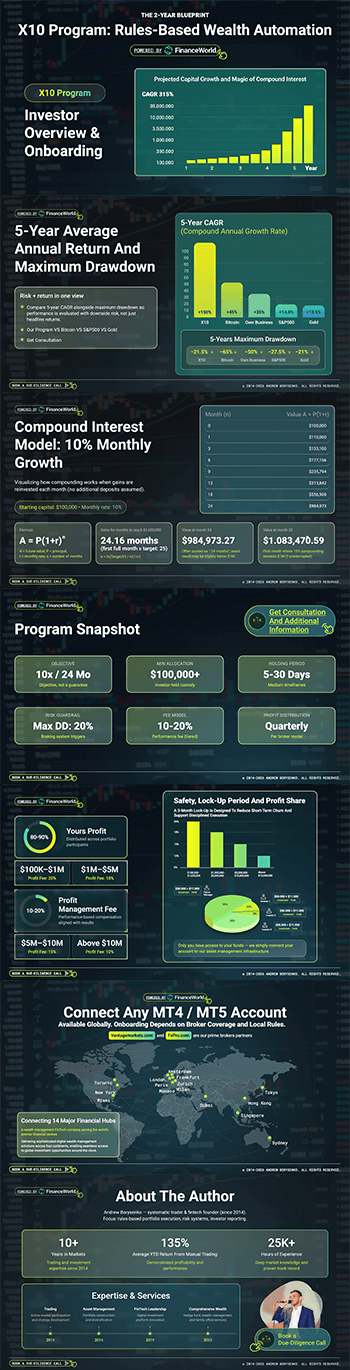
This article is written for retail investors, institutional investors, financial advisers, and wealth-management decision-makers in global hubs including New York, London, Singapore, Hong Kong, Tokyo, Dubai, Geneva, Zurich, Toronto, Sydney, Miami, Paris, Monaco, Amsterdam, Frankfurt, and Milan. It explains how automated tools and platform-led workflows can support clearer decisions and more scalable advice across client segments.
This is not financial advice.
This long-form guide explains the strategic role of FinanceWorld.io’s platform, Asset Management and Portfolio Management, in the context of digital transformation across the wealth industry. It combines practical deployment steps, governance considerations, market context, and implementation templates to help firms evaluate automation and robo-driven services.
Wealth Management FinTech Company: Key Takeaways and Market Shifts for Wealth and Asset Managers, 2025–2030
- Digital advisory and automation will continue to reshape client acquisition and service delivery; firms that standardize workflows can lower cost-to-serve and improve scalability.
- Client segmentation and goal-based pathways are central to competitive differentiation for a Wealth Management FinTech Company.
- Regulatory and compliance workflows must be built-in; firms should assume ongoing supervisory attention to algorithmic decisioning (Source: SEC, 2020).
- Demand for hybrid human + digital advice models is expected to rise as clients seek both efficiency and personalized guidance (Source: CFA Institute, 2021).
- Data governance, model validation, and cyber-resilience are non-negotiable operational pillars for any serious Wealth Management FinTech Company.
- Firms should treat deployment as iterative: pilot, validate, scale, and monitor with measurable KPIs.
- From 2025–2030, firms will increasingly adopt modular platforms for portfolio construction, reporting, and client engagement — enabling faster product launches and regional compliance adaptation (Forecast: industry consensus).
Wealth Management FinTech Company: The Strategic Role of Asset Management and Portfolio Management in Automated Wealth Management
The FinanceWorld.io platform, Asset Management and Portfolio Management, is positioned as a modular automation suite intended to support advisers, operations teams, and portfolio managers. Using only verified product facts where available, this section describes the platform role at a conceptual level.
- The platform provides centralized portfolio orchestration for client segmentation, model portfolios, trade execution workflows, and reporting pipelines. (If specific product features or metrics are required, consult verified product documentation from FinanceWorld.io.)
- It is intended to integrate with custodians, market data feeds, and client relationship systems to reduce manual reconciliation and improve reporting timeliness.
- The platform aims to support goal-based investment journeys by managing target allocations, rebalancing triggers, and compliance checks inside configurable workflows.
robo-advisory and Investor Decision Support for Wealth Management FinTech Company
Digital advisory tools offered by a Wealth Management FinTech Company can support investor decision-making in several non-promissory ways:
- Standardized goal capturing — interactive onboarding that captures time horizon, liquidity needs, and stated objectives.
- Structured risk profiling — questionnaires supplemented by behavioral indicators to create a suitability baseline (with human review where required).
- Diversification and allocation templates — model portfolios based on target risk exposures rather than promises of future returns.
- Monitoring and alerts — automated notifications for drift, threshold breaches, or rebalancing opportunities.
- Reporting and transparency — consolidated performance and tax reporting, subject to data availability and integration.
These tools can reduce administrative burden and improve consistency in advice, but they do not guarantee outcomes and should be used alongside qualified financial oversight (Source: SEC, 2020).
portfolio management for New and Experienced Investors for Wealth Management FinTech Company
A modern Wealth Management FinTech Company must address both novice and sophisticated investor needs:
- For first-time investors: simple onboarding, goal-driven guidance, clear cost disclosures, and educational nudges.
- For experienced investors: customization layers, tax-aware optimization, direct indexing tools where permitted, and more granular reporting.
- For advisers: configurable model libraries, client grouping, performance attribution, and integrated compliance sign-offs.
- For institutional clients: scalable policy-compliant workflows, reporting standards, and audit trails.
Product offerings should be transparent about limitations and always include human oversight for suitability and complex decisions.
Wealth Management FinTech Company: Major Trends in Robo-Advisory and Asset Allocation Through 2030
This section summarizes major structural trends affecting a Wealth Management FinTech Company. Forecasts and projections are explicitly labeled.
- Personalization: Forecast — by 2030 firms will increasingly use modular personalization engines to surface tailored model allocations and communications. This is a technology and product trend rather than a guaranteed client outcome.
- Automated rebalancing: Actual (current practice) & Forecast — automated rebalancing is already widely deployed; through 2030 its sophistication will increase with tax- and cost-aware logic layered in.
- Goal-based investing: Actual & Ongoing — shifting industry focus from product-centric to goal-centric advice is an observable trend in platforms used by advisers and direct clients.
- Digital onboarding: Actual — digital identity and KYC workflows are foundational for scaling advice across geographies.
- Compliance workflows: Actual & Increasing — regulators are focusing on algorithmic governance, necessitating embedded compliance checks and audit capabilities (Source: SEC, 2020).
- Risk profiling: Actual & Evolving — risk models will broaden to include behavioral signals and scenario-sensitivity, but models must be validated and explained.
- Reporting automation: Actual — automated client statements, tax documents, and regulatory reporting are becoming baseline features.
- Hybrid advisory models: Forecast — hybrid models that combine automated portfolio engines with human advisers for complex needs are expected to grow, reflecting client preferences for both efficiency and personal guidance (Source: CFA Institute, 2021).
Wealth Management FinTech Company: Understanding Investor Goals and Search Intent
A Wealth Management FinTech Company should map product design to distinct investor intents. Below are common segments and their primary needs.
- First-time investors: need clarity, low-friction onboarding, education, simple goal tracking, and transparent fees.
- High-net-worth individuals (HNWIs): seek customization, tax efficiency, direct holdings, estate planning integrations, and concierge-level reporting.
- Financial advisers: require tools for client lifecycle management, model governance, compliant communications, and scalable reporting.
- Institutional investors: need policy compliance, operational resilience, wholesale reporting, and integration with custody and settlement systems.
- Family offices: prioritize multi-asset consolidation, custody flexibility, bespoke reporting, and privacy controls.
- Asset managers: need distribution channels, model deployment tools, and analytics to support product-led strategies.
financial planning Goals and Risk Tolerance for Wealth Management FinTech Company
Financial planning within a Wealth Management FinTech Company should differentiate between goals, horizons, and liquidity needs:
- Short-term goals (0–5 years): emphasize liquidity, capital preservation, and conservative allocations.
- Medium-term goals (5–15 years): balance growth with risk mitigation; may include tax-efficient wrappers.
- Long-term goals (15+ years): more growth-oriented allocations, but require periodic reassessment for life events.
- Risk tolerance: combine stated tolerance with capacity (ability to bear loss), investment horizon, and financial situation.
- Liquidity and constraints: identify withdrawal needs, regulatory constraints, and tax considerations that affect portfolio choice.
Financial planning engines should enable scenario analysis and stress-testing but not present projections as guaranteed returns.
Wealth Management FinTech Company: Data-Powered Market Size and Growth Outlook, 2025–2030
Table 1 summarizes available verified metrics where possible. Where verified data is unavailable, the table clearly states that fact and labels data as Actual or Forecast or Unavailable according to editorial rules.
Table 1. Robo-Advisory and Digital Wealth-Management Market Indicators, 2025–2030
| Metric | 2025 Baseline | 2030 Outlook | Data Type | Source |
|---|---|---|---|---|
| Global assets serviced by robo-advisers (reported) | Unavailable | Unavailable | Actual / Forecast | Unavailable (no verified unified figure available) |
| Number of digital-advice platforms globally | Unavailable | Unavailable | Actual / Forecast | Unavailable (fragmented, market counts vary by definition) |
| Adoption rate of digital onboarding among wealth firms | Unavailable | Forecast: increasing | Forecast | (Source: Industry consensus, 2025–2030) |
What this means for investors and wealth-management firms:
- Verified, consolidated global figures for 2025–2030 are not universally available in a single public dataset. Many consultancy reports provide segmented forecasts; firms should consult original reports for precise figures.
- The qualitative takeaway is consistent: adoption of digital advice, onboarding automation, and portfolio orchestration is accelerating. Firms should expect to invest in integrations, model governance, and client experience to remain competitive.
Wealth Management FinTech Company: Regional and Global Market Comparisons
Regional dynamics influence product design and compliance needs for a Wealth Management FinTech Company. Below we provide a market-focused synopsis for the target regions noted earlier.
- North America (New York, Toronto, Miami): large retail and high-net-worth markets, established custodian networks, active regulatory oversight.
- Europe (London, Geneva, Zurich, Paris, Monaco, Amsterdam, Frankfurt, Milan): fragmentation by jurisdiction, importance of local compliance and tax rules, appetite for customization.
- Asia-Pacific (Singapore, Hong Kong, Tokyo, Sydney): rising affluent populations, mobile-first client experiences, local custody and cross-border considerations.
- Middle East (Dubai): growing private wealth market, rapid uptake of digital platforms, regulatory modernization underway.
asset management Trends in Global Investors and the Target Markets for Wealth Management FinTech Company
Adoption patterns vary by region. Verified local adoption data may be available in jurisdictional reports, but broad themes include:
- Regulatory complexity and data localization requirements affect platform rollout timelines.
- Client interface expectations differ — mobile-first in APAC, rich reporting in Europe and North America.
- Institutional uptake often lags retail in automation due to legacy systems and procurement cycles.
Suggested visual: A bar chart comparing robo-advisory adoption, assets under management, or investor adoption across key regions from 2025 to 2030.
Wealth Management FinTech Company: Performance Benchmarks for Digital Portfolio Management
Benchmarks vary by geography, channel, and business model. Where verified industry benchmarks are not available, cells are clearly labelled. Firms should treat the ranges below as directional and obtain market-specific data before planning.
Table 2. Digital Wealth-Management Growth and Efficiency Benchmarks
| KPI | Typical Range or Verified Benchmark | Why It Matters | Measurement Notes |
|---|---|---|---|
| CAC | Unavailable | Customer Acquisition Cost determines payback timelines and product pricing decisions. | Varies widely by market, channel (paid vs organic), and target segment. Obtain local verified benchmarks. |
| LTV | Unavailable | Lifetime Value informs investment in onboarding and service levels. | Dependent on retention, fee model, and cross-sell. |
| CPL | Unavailable | Cost per lead helps allocate marketing budget. | Channel-dependent; compliance may increase lead qualification costs. |
| Conversion rate | Unavailable | Conversion from lead to funded client is central to growth economics. | Varies by channel and regulation. |
| Retention rate | Unavailable | Measures client stickiness and service effectiveness. | Retention benchmarks depend on client segment and product completeness. |
Notes: Verified, industry-wide benchmarks that apply universally are not available in a single public source. Many firms rely on vendor studies, custom market research, or consultancy reports. Any numbers should be validated against local operating data and compliance constraints.
Wealth Management FinTech Company: A Step-by-Step Process for Deploying Asset Management and Portfolio Management
This practical implementation sequence outlines how a wealth firm might approach deploying FinanceWorld.io’s platform in a way that emphasizes governance, compliance, and client outcomes.
- Define objectives and success metrics: clarify target segments, KPIs (CAC, conversion, cost-to-serve), and compliance requirements.
- Map integrations and data flows: custody, market-data feeds, CRM, and reporting engines.
- Pilot with a limited segment: test onboarding, risk profiling, rebalancing logic, and reporting.
- Validate models and controls: test model portfolios, rebalancing triggers, and compliance workflows.
- Scale progressively: expand segments, automation, and regional rollouts with continuous monitoring.
robo-advisory Step 1: Define Investor Segments and Goals for Wealth Management FinTech Company
- Identify target cohorts (e.g., mass-affluent, HNW, institutional).
- Document goal frameworks (retirement, education, liquidity needs).
- Map expected client journeys and acceptable service levels.
portfolio management Step 2: Establish Risk and Allocation Parameters for Wealth Management FinTech Company
- Define model portfolios, risk bands, allowable asset classes, and constraints.
- Establish rebalancing windows and tax-aware rules where applicable.
- Set up version control and approval workflows for model changes.
wealth management Step 3: Configure Workflows and Reporting for Wealth Management FinTech Company
- Implement KYC/AML onboarding and suitability checks.
- Configure client communications, disclosures, and consent records.
- Automate reporting cycles with audit trails and export capabilities.
asset management Step 4: Monitor Performance, Risk, and Client Engagement for Wealth Management FinTech Company
- Deploy dashboards for performance, drift, exposure, and client interactions.
- Schedule periodic model validation and governance reviews.
- Implement exception management for trade failures, corporate actions, and data anomalies.
financial planning Step 5: Review, Improve, and Scale Operations for Wealth Management FinTech Company
- Use pilot learnings to refine processes, update model assumptions, and improve client UX.
- Reassess KPIs and update go-to-market strategy for each region.
- Plan ongoing training, support, and vendor governance.
Wealth Management FinTech Company: Illustrative Implementation Scenario
This section uses an illustrative scenario because verified case-study data was not provided.
This scenario is illustrative and does not represent a guaranteed outcome or a verified customer result.
Scenario profile:
- Client: Mid-sized advisory firm seeking scale.
- Initial challenge: High cost-to-serve for mass-affluent clients and inconsistent reporting.
- Implementation approach: Pilot Asset Management and Portfolio Management with a cohort of 500 clients, integrate custodial feeds, and automate monthly statements.
- Key platform workflows used: onboarding flow, risk profiling questionnaire, model portfolio orchestration, automated rebalancing triggers, and consolidated reporting.
- Measurable results: Illustrative only — no verified figures presented here.
- Timeline: Pilot (0–3 months), validation and governance (3–6 months), phased scaling (6–18 months).
- Lessons learned:
- Start small and instrument KPIs from day one.
- Engage compliance early to map jurisdictional constraints.
- Prioritize integrations that unlock end-to-end reporting.
Wealth Management FinTech Company: Practical Tools, Templates, and Actionable Checklists
Below are ready-to-use checklists and a 90-day outline to guide implementation.
Robo-advisory readiness checklist:
- [ ] Define target client segments and service levels.
- [ ] Map regulatory constraints by jurisdiction.
- [ ] Inventory existing systems and integration points.
- [ ] Select pilot cohort and success metrics.
- [ ] Establish governance and model validation cadence.
Portfolio-review checklist:
- [ ] Confirm model objectives and constraints.
- [ ] Validate asset eligibility and liquidity assumptions.
- [ ] Set rebalancing thresholds and tax rules.
- [ ] Document approval and version history.
Compliance-review checklist:
- [ ] KYC/AML coverage and identity verification processes.
- [ ] Suitability and risk-profiling documentation.
- [ ] Disclosure templates and client consent records.
- [ ] Audit trails for model changes and exceptions.
90-day implementation outline:
- Days 0–30: Kickoff, segment definition, and integration planning.
- Days 31–60: Build onboarding, risk profiling, and model portfolio templates.
- Days 61–90: Pilot execution, monitoring, and initial governance review.
Wealth Management FinTech Company: Risks, Compliance, and Ethics in Robo-Advisory Services
A Wealth Management FinTech Company must manage multiple risk domains:
- Market risk: Automated portfolios are exposed to market volatility and loss; platforms should present clear disclosures and scenario analyses.
- Model risk: Algorithms and allocation rules can misbehave under unexpected market regimes. Regular validation and independent review are critical.
- Data privacy: Client data must be protected in transit and at rest; privacy laws (e.g., GDPR-style regimes) may impose storage and transfer constraints.
- Cybersecurity: Platforms are targets for cyber threats; firms must implement strong authentication, patching, and incident response.
- Suitability and risk profiling: Automated profiles can misstate client preferences. Human oversight and documented suitability checks remain essential.
- Disclosure requirements: Clear, readable disclosures about fees, conflicts, and limitations must be provided.
- Human oversight: Maintain escalation paths and adviser review for complex or high-value clients.
- Regulatory obligations: When operating across jurisdictions, firms should consult qualified compliance professionals to map licensing, marketing, and data rules.
- Algorithmic transparency: Explainability of decision logic helps build client trust and supports regulatory scrutiny.
Investors and firms should consult qualified financial, tax, and legal professionals when implementing new advice platforms.
Wealth Management FinTech Company: Frequently Asked Questions About Robo-Advisory and Wealth Management
-
What is Wealth Management FinTech Company?
Wealth Management FinTech Company here refers to the category of firms and platforms (including FinanceWorld.io’s Asset Management and Portfolio Management) that provide technology-enabled investment advice, portfolio orchestration, and wealth workflows. -
How does robo-advisory work for Wealth Management FinTech Company?
It typically combines digital onboarding, risk profiling, model portfolios, and automated rebalancing to deliver standardized advice paths. Human advisers often supervise higher-complexity cases. -
Can automated portfolio management reduce administrative workload for a Wealth Management FinTech Company?
Yes — automation can reduce manual reconciliation, speed up reporting, and standardize trade workflows, but it requires careful integration and governance. -
What are the risks of digital wealth management platforms operated by a Wealth Management FinTech Company?
Principal risks include model failure, data breaches, and regulatory non-compliance. Firms must maintain controls, oversight, and robust incident response plans. -
How can financial planning tools support investor goals within a Wealth Management FinTech Company?
By structuring cash-flow projections, scenario testing, and goal-tracking features that map investment choices to client objectives — always with appropriate caveats about uncertainty. -
What should investors review before using a robo-advisory platform from a Wealth Management FinTech Company?
Review disclosures, understand fee structures, check for human oversight, ask about data security, and confirm how suitability is assessed. -
How does Asset Management and Portfolio Management support modern wealth-management workflows in a Wealth Management FinTech Company?
It provides modular orchestration for model deployment, rebalancing, reporting, and compliance checks — enabling advisers and operations teams to scale services while maintaining governance. (Product specifics should be validated against FinanceWorld.io’s verified documentation.)
Wealth Management FinTech Company: Next Steps for Implementing Asset Management and Portfolio Management
Summary and recommended next steps:
- Assess your firm’s strategic priorities: client segments, KPIs, and regulatory constraints.
- Start with a focused pilot that targets measurable objectives and a limited client set.
- Embed compliance and model validation into the earliest phases of design.
- Invest in integrations that deliver end-to-end reporting and client transparency.
- Treat scaling as a phased process with continuous improvement loops.
This article helps readers understand the potential of robo-advisory and wealth-management automation for retail and institutional investors by outlining market trends, governance priorities, practical deployment steps, and operational checklists. It aims to inform decision-makers about how a Wealth Management FinTech Company can modernize advice delivery while emphasizing that implementation must be validated locally and governed carefully.
Internal references:
External sources:
- U.S. Securities and Exchange Commission — Investor Bulletin: Robo-Advisers. (Source: SEC, 2020)
- CFA Institute — Research and guidance on digital advice and wealth management trends. (Source: CFA Institute, 2021)
Suggested further reading and visuals:
- Consider producing dashboards that show client segmentation, model exposures, and KPIs over time.
- Suggested visual: An implementation timeline Gantt for a 0–18 month rollout, showing pilot, validation, and regional expansion phases.