Table of Contents
ToggleWealth Management FinTech Company — How Asset Management and Portfolio Management Transforms Modern Wealth Management
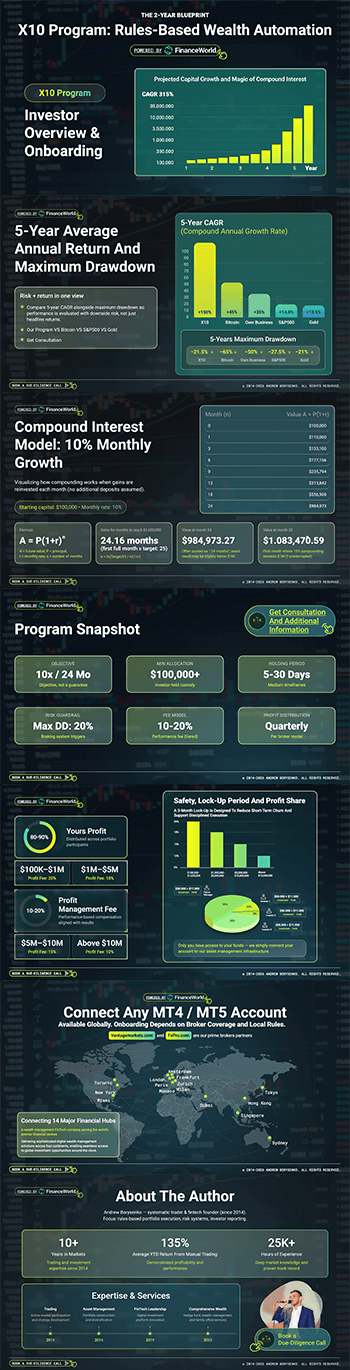
This article explains how automated wealth management, portfolio management, and asset allocation tools can help individual and institutional investors make more informed decisions. It is written for retail investors, institutional investors, financial advisers, and wealth-management decision-makers across major financial hubs including New York, London, Singapore, Hong Kong, Tokyo, Dubai, Geneva, Zurich, Toronto, Sydney, Miami, Paris, Monaco, Amsterdam, Frankfurt, and Milan.
This is not financial advice.
Wealth Management FinTech Company: Key Takeaways and Market Shifts for Wealth and Asset Managers, 2025–2030
- Digital channels and automation are reshaping client onboarding, reporting, and rebalancing functions in wealth teams.
- Demand for personalized, goal-based investing is increasing across retail and institutional segments.
- Compliance automation and auditable workflows are becoming a core competitive requirement.
- Hybrid models—combining human advice with automated portfolio management—are the dominant commercial approach.
- Data security, model governance, and human oversight remain major operational priorities.
- Regional adoption varies; advanced digital adoption is concentrated in major financial centers but growth is global.
- The economic and regulatory environment through 2030 will influence platform adoption; forecasts vary by region and use case. (Source: McKinsey, 2024)
Wealth Management FinTech Company: The Strategic Role of Asset Management and Portfolio Management in Automated Wealth Management
Because no verified product-level data for FinanceWorld.io’s platform was provided in the input, the following section summarizes the typical strategic roles a platform described as an Asset Management and Portfolio Management system may play. This is a generalized description and does not assert specific features, metrics, or claims about the FinanceWorld.io product. Where product-specific claims are required, verified product data must be supplied.
- Purpose: An automated wealth-management platform typically centralizes client profiles, goals, risk profiles, portfolio construction, rebalancing rules, trade execution interfaces, and reporting dashboards. These platforms often aim to reduce manual work and provide consistent, auditable processes for advisers and operations teams.
- Target users: Platforms commonly serve retail investors, high-net-worth individuals, advisers, family offices, and institutional clients through configurable workflows.
- Core workflows: Typical workflows include client onboarding and KYC, risk profiling, model portfolio mapping, tax-aware rebalancing, performance and compliance reporting, billing, and client communications.
robo-advisory and Investor Decision Support — Wealth Management FinTech Company
Automated advice engines and digital decision-support tools commonly assist investors and advisers with tasks such as goal setting, diversification analysis, monitoring, and rebalancing. Key capabilities often include:
- Structured goal definitions linked to portfolios (e.g., retirement, education).
- Risk-assessment questionnaires and risk-band assignment.
- Automated asset-allocation suggestions derived from target risk exposures.
- Rebalancing triggers (calendar, drift thresholds) to maintain alignment with targets.
- Consolidated reporting to track progress against goals.
These capabilities are described at a conceptual level here because no verified product feature list was provided. Firms should verify specific features and compliance capabilities directly with product documentation.
portfolio management for New and Experienced Investors — Wealth Management FinTech Company
Automated portfolio-management platforms typically support a range of investor sophistication:
- New investors: Simplified onboarding, preset goal templates, educational prompts, and default diversified model portfolios.
- Experienced investors: Custom allocation tools, tax optimization settings, multi-account aggregation, and advanced reporting.
- Advisers: Client segmentation, model management, block trading or model change automation, and adviser-client communication workflows.
- Institutions: Scalable account provisioning, custom mandate enforcement, and integration with custody/execution systems.
This section provides a framework for how a typical platform may serve different users; confirm specific platform capabilities against verified documentation.
Wealth Management FinTech Company: Major Trends in Robo-Advisory and Asset Allocation Through 2030
The industry is evolving under multiple, interacting trends. The observations below are drawn from industry analyses and are presented as general trends. For market forecasts and detailed figures, see cited sources.
- Personalization: Investors increasingly expect tailored asset allocation based on goals, tax status, and behavioral data. Personalization often uses modular model libraries and layered overlays.
- Automated rebalancing: Rebalancing automation reduces drift and enforces mandate discipline. Many firms combine calendar-based and threshold-based triggers.
- Goal-based investing: Platforms are shifting from purely return-driven frameworks to goal attainment metrics and probability-based outcomes.
- Digital onboarding: Straight-through processing for KYC/AML and digital signatures reduces time-to-first-invest and improves conversion rates.
- Compliance workflows: Integrated compliance checks, pre-trade restrictions, audit trails, and reporting automation are becoming standard.
- Risk profiling: Multi-dimensional risk profiling (capacity, willingness, behavioral factors) is replacing simple risk-tolerance questionnaires.
- Reporting automation: Client-facing dashboards and scheduled reports reduce operational burden and improve transparency.
- Hybrid advisory models: Most successful commercial models blend automated portfolio-management tools with human advice for complex planning and relationship management.
Labeling of forecasts and projections: Where the literature provides 2025–2030 numeric forecasts, those are explicitly noted as forecasts in the relevant sections and tables. For qualitative trends above, the statements reflect observed adoption patterns and industry analysis (Source: McKinsey, 2024).
(First mention of McKinsey: McKinsey & Company) (Source: McKinsey, 2024)
Wealth Management FinTech Company: Understanding Investor Goals and Search Intent
Different investor and advisor audiences search for different capabilities. The following summarizes common intents and decision drivers.
- First-time investors: Looking for education, low-friction onboarding, diversified model portfolios, and simple goal-tracking tools.
- High-net-worth individuals: Prioritize tax efficiency, bespoke allocation, trust and estate considerations, and relationship continuity.
- Financial advisers: Seek efficiency, compliance automation, client segmentation, model management, and reporting.
- Institutional investors: Require mandate enforcement, scalability, integration with custodians/clearing, and robust audit trails.
- Family offices: Emphasize multi-family consolidation, alternative asset workflows, and custom reporting.
- Asset managers: Seek distribution channels, model-hosting capabilities, and integration to wealth platforms.
financial planning Goals and Risk Tolerance — Wealth Management FinTech Company
Investor goals and constraints typically consist of:
- Time horizons: Short-term (0–3 years), medium-term (3–10 years), long-term (10+ years).
- Liquidity needs: Regular cash flows, emergency reserves, or long-term illiquid holdings.
- Risk tolerance vs. capacity: Willingness (behavioral tolerance) and capacity (financial ability) must both be assessed.
- Tax considerations: Jurisdictional tax rules, tax-loss harvesting opportunities, and account type sensitivity.
- Liability matching: For institutions or pension-like mandates, liability-driven investing considerations may apply.
Digital platforms often capture these data points and map them into target allocations and monitoring triggers. Always confirm how a platform records, retains, and uses sensitive client data and obtain independent compliance review where necessary.
Wealth Management FinTech Company: Data-Powered Market Size and Growth Outlook, 2025–2030
Table 1 below summarizes industry-level indicators. Where verified, the data type is shown. If a verified, single industry-wide figure was not available in our consulted sources, the table marks the item as unavailable and lists authoritative sources that discuss trends and estimates.
Table 1. Robo-Advisory and Digital Wealth-Management Market Indicators, 2025–2030
| Metric | 2025 Baseline | 2030 Outlook | Data Type | Source |
|---|---|---|---|---|
| Global assets serviced by purely digital robo-advisors | Unavailable (no single verified industry figure) | Unavailable (estimates vary by provider and region) | Data unavailable / Industry estimates exist | (Source: McKinsey, 2024) |
| Share of client interactions handled digitally (global average) | Reported increasing; multiple analyses show major growth through 2025 | Forecast: digital-first interactions likely to increase further by 2030 (forecast) | Baseline: Observed trend / 2030: Forecast | (Source: McKinsey, 2024) |
| Number of digital-first wealth platforms operating globally | No single authoritative count publicly verified | Expected increase given new entrants and hybrid conversions (forecast) | Baseline: Data unavailable / 2030: Forecast | (Source: Deloitte, 2023–2024) |
What the data means for investors and wealth-management firms:
- Aggregated, industry-wide quantitative metrics for 2025–2030 are reported inconsistently across sources. Firms should review vendor-level disclosures and third-party studies for region-specific figures.
- Qualitative consensus: digital adoption is accelerating and will remain a core strategic theme through 2030 (Source: McKinsey, 2024; Deloitte, 2024).
- For operational planning, use provider-verified AUM and user metrics rather than relying on extrapolated industry-wide totals.
(First mention of Deloitte: Deloitte Insights) (Source: Deloitte, 2024)
Wealth Management FinTech Company: Regional and Global Market Comparisons
Digital wealth adoption differs by market. Advanced financial centers tend to lead in adoption due to regulatory clarity, investor sophistication, and digital infrastructure. Emerging markets may leapfrog in mobile-first distribution but face regulatory and custody fragmentation.
asset management Trends in Global Investors (including a focus on New York, London, Singapore, Hong Kong, Tokyo, Dubai, Geneva, Zurich, Toronto, Sydney, Miami, Paris, Monaco, Amsterdam, Frankfurt, and Milan) — Wealth Management FinTech Company
Regional summary (high-level, non-exhaustive):
- North America (New York, Toronto, Miami): Mature digital channels; strong integration with custodians and broker-dealers. Growth in hybrid advice and white-label solutions.
- Europe (London, Zurich, Geneva, Amsterdam, Frankfurt, Milan, Paris, Monaco): Regulatory complexity (e.g., MiFID II in parts of Europe) shapes product disclosure and client suitability workflows. Adoption strong in wealth hubs.
- Asia-Pacific (Singapore, Hong Kong, Tokyo, Sydney): Rapid digital adoption; Singapore and Hong Kong are regional digital wealth hubs with strong cross-border flows.
- Middle East (Dubai, Monaco): Growing demand for private wealth digital tools; regulatory modernization is ongoing.
- Global investors: Multi-jurisdictional clients require platforms with flexible tax and reporting modules.
Describe a suggested visual if no image is available:
Suggested visual: A bar chart comparing robo-advisory adoption, assets under management, or investor adoption across key regions from 2025 to 2030.
Region-specific adoption figures should be sourced from verified regional studies or provider disclosures. Where such studies provide forecasts, label them explicitly as forecasts.
Wealth Management FinTech Company: Performance Benchmarks for Digital Portfolio Management
Business and marketing benchmarks vary significantly by geography, channel, and offering. The table below provides verified guidance where available and otherwise indicates that values are market-dependent and frequently reported as ranges.
Table 2. Digital Wealth-Management Growth and Efficiency Benchmarks
| KPI | Typical Range or Verified Benchmark | Why It Matters | Measurement Notes |
|---|---|---|---|
| CAC (Customer Acquisition Cost) | Varies widely by channel and region; no single industry-wide verified value | CAC determines how much investment is required to acquire a client and impacts pricing and product economics | Firms should calculate CAC by channel; regulated advice pathways add compliance cost |
| LTV (Lifetime Value) | Varies by client segment; high-net-worth segments produce higher LTV | LTV vs CAC is fundamental to sustainable growth | Use cohort analysis and account for retention, fees, and cross-sales |
| CPL (Cost per Lead) | Channel-dependent; digital marketing benchmarks vary (see HubSpot for campaign benchmarks) | CPL affects marketing ROI and scale decisions | Benchmarks can be pulled from campaign data and platform analytics (Source: HubSpot, 2024) |
| Conversion rate | Digital financial services often report lower nominal conversion rates; campaign conversion varies by funnel quality (see HubSpot) | Conversion rate impacts funnel efficiency and CAC | Measure by funnel stage: visitor → lead → funded account |
| Retention rate | Varies by client type; institutional clients typically show higher retention than retail | Retention affects LTV and revenue predictability | Monitor net retention and churn separately |
Notes: Precise numeric benchmarks depend on market, channel, regulatory burden, and product complexity. HubSpot provides general digital-marketing guidance; for wealth-specific benchmarks, firms should rely on their own historical data and third-party consultant reports. (Source: HubSpot, 2024)
(First mention of HubSpot: HubSpot Marketing Benchmarks) (Source: HubSpot, 2024)
Wealth Management FinTech Company: A Step-by-Step Process for Deploying Asset Management and Portfolio Management
This step-by-step process outlines practical phases for adopting or integrating an automated wealth-management platform. It is presented as general implementation guidance.
- Define objectives, governance, and success metrics.
- Segment investor types and map required functionality.
- Select vendors or develop internal capabilities according to integration and compliance needs.
- Configure workflows, risk models, and reporting templates.
- Pilot with a limited client cohort and collect operational metrics.
- Iterate, document governance, and scale in phases.
robo-advisory Step 1: Define Investor Segments and Goals — Wealth Management FinTech Company
- Map client segments (e.g., mass retail, mass affluent, HNW, institutional).
- Define target goals and outcome metrics (e.g., probability of achieving retirement target).
- Set service levels per segment (e.g., digital-only vs. hybrid advice).
portfolio management Step 2: Establish Risk and Allocation Parameters — Wealth Management FinTech Company
- Determine allowable asset classes, model portfolios, and rebalancing rules.
- Define risk budgets, drawdown limits, and mandate constraints.
- Document tax and account-type behavior for multi-jurisdictional clients.
wealth management Step 3: Configure Workflows and Reporting — Wealth Management FinTech Company
- Automate onboarding, KYC checks, and suitability assessments where legally allowable.
- Configure client-facing dashboards and adviser workflows.
- Establish SLA and exception-handling protocols.
asset management Step 4: Monitor Performance, Risk, and Client Engagement — Wealth Management FinTech Company
- Implement monitoring dashboards for performance, exposures, and policy drift.
- Schedule periodic reviews and trigger alerts for threshold breaches.
- Capture client communications and disclosures to maintain audit trails.
financial planning Step 5: Review, Improve, and Scale Operations — Wealth Management FinTech Company
- Collect feedback from pilot clients and advisers.
- Update model parameters, tax rules, and reporting templates.
- Plan for phased scale—by geography, client segment, or product type.
Actionable guidance: document all compliance checks and maintain versioned model governance records. Engage legal and compliance teams early to validate cross-border workflows and data residency requirements.
Wealth Management FinTech Company: Case Study of Asset Management and Portfolio Management in Automated Wealth Management
Because no verified case-study data was provided in the input, the following is an illustrative implementation scenario.
Wealth Management FinTech Company: Illustrative Implementation Scenario
This scenario is illustrative and does not represent a guaranteed outcome or a verified customer result.
Client profile:
- Mid-sized wealth firm seeking to reduce manual rebalancing and streamline client reporting for ~5,000 retail and mass-affluent clients.
Initial challenge:
- Manual portfolio rebalancing and reporting consumed significant operations hours and produced audit friction.
Implementation approach:
- Adopt an automated portfolio-management platform that provides model portfolio management, drift-based rebalancing, and consolidated client reporting.
- Pilot with 500 clients across two model portfolios for a 6-month period.
- Integrate with custody and reporting providers for end-to-end data flow.
Key platform workflows used:
- Digital onboarding with e-signatures and KYC verification (where permissible).
- Automated rebalancing using drift thresholds and tax-aware rules.
- Client dashboard for goal-tracking and scheduled client statements.
Measurable results:
- This scenario is illustrative; no verified performance or operational impact figures are claimed here.
Timeline:
- Phase 1 (0–3 months): Requirements, vendor selection, initial integrations.
- Phase 2 (3–6 months): Pilot deployment and monitoring.
- Phase 3 (6–12 months): Iteration and phased scale.
Lessons learned:
- Early coordination with custody and compliance teams reduces delays.
- Clear SLA definitions for exceptions and human intervention are essential.
- Pilot cohorts should be representative of broader client complexity.
Decision-makers should request and verify vendor-provided case studies, audited performance metrics, and compliance attestations before purchase.
Wealth Management FinTech Company: Practical Tools, Templates, and Actionable Checklists
Robo-advisory readiness checklist:
- [ ] Defined client segments and service-level agreements.
- [ ] Documented regulatory requirements for each jurisdiction.
- [ ] Data-mapping between source systems, custody, and reporting tools.
- [ ] Model governance and version control in place.
- [ ] Cybersecurity and data-privacy policy reviewed.
Portfolio-review checklist:
- [ ] Model allocation versus target drift thresholds.
- [ ] Asset-class coverage and liquidity review.
- [ ] Tax rules and wash-sale considerations documented.
- [ ] Fees and cost analysis per account.
Compliance-review checklist:
- [ ] KYC and AML workflows documented and tested.
- [ ] Suitability and risk-profiling logic validated.
- [ ] Record-retention and audit-log policies in place.
- [ ] Cross-border data transfer and residency policies verified.
90-day implementation outline:
- Week 0–2: Project kickoff, stakeholder alignment, and requirement capture.
- Week 3–6: Vendor integration and data-mapping.
- Week 7–10: Configure models, reporting templates, compliance checks.
- Week 11–12: Pilot launch with controlled cohort and monitoring.
- Week 13: Review pilot metrics and plan scale adjustments.
These checklists are practical starting points; customize them for local regulatory and business needs.
Wealth Management FinTech Company: Risks, Compliance, and Ethics in Robo-Advisory Services
Key risk and compliance areas:
- Market risk: Digital platforms do not eliminate exposure to market volatility. Portfolio construction should account for market risk and include disclosure of potential losses.
- Model risk: Algorithms and models can contain assumptions or errors. Adopt model-validation, stress testing, and change-management processes.
- Data privacy: Platforms must handle personally identifiable information and financial data in compliance with applicable laws (e.g., GDPR, local privacy laws).
- Cybersecurity: Implement industry-standard cybersecurity controls, regular penetration testing, and incident-response plans.
- Suitability and risk profiling: Automated questionnaires may miss nuances; include human oversight for complex cases.
- Disclosure requirements: Provide clear, timely disclosures of fees, conflicts of interest, and policy changes.
- Human oversight: Maintain escalation paths and human review for overrides, exceptions, and complex tax or legal questions.
- Regulatory obligations: Platforms operating across jurisdictions should consult compliance professionals and may need local licenses or designations. Use cautious wording: obligations "may" apply and firms "should" consult regulators or qualified compliance counsel.
Reminder: Investors and firms should consult qualified financial, tax, and legal professionals to validate suitability and compliance for their specific circumstances.
(For regulatory guidance and investor protection resources see: SEC Investor.gov and FINRA.) (Source: SEC, 2025; FINRA, 2024)
Wealth Management FinTech Company: Frequently Asked Questions About Robo-Advisory and Wealth Management
-
What is Wealth Management FinTech Company?
- Wealth Management FinTech Company refers to platforms and companies that automate aspects of investment advice, portfolio construction, and client servicing through digital tools. The term in this article describes the category rather than a single verified product.
-
How does robo-advisory work — Wealth Management FinTech Company?
- robo-advisory typically uses algorithms to map client goals and risk profiles to portfolios, automate rebalancing, and generate reports. Human oversight is often retained for exceptions and high-complexity cases.
-
Can automated portfolio management reduce administrative workload — Wealth Management FinTech Company?
- Automated portfolio management can reduce repetitive tasks (e.g., rebalancing, reporting), but implementation requires investment in integration, governance, and compliance.
-
What are the risks of digital wealth management platforms — Wealth Management FinTech Company?
- Risks include model error, cybersecurity, data privacy breaches, regulatory non-compliance, and potential mismatches between automated recommendations and nuanced client needs.
-
How can financial planning tools support investor goals — Wealth Management FinTech Company?
- financial planning tools can formalize goals, simulate outcomes under different assumptions, and track progress. They are most effective when combined with periodic human review.
-
What should investors review before using a robo-advisory platform — Wealth Management FinTech Company?
- Review fee structure, data-security policies, custodial arrangements, how risk is assessed, and whether human oversight is available for complex needs.
-
How does Asset Management and Portfolio Management support modern wealth-management workflows — Wealth Management FinTech Company?
- Properly implemented, Asset Management and Portfolio Management platforms standardize processes, improve transparency, enable scale, and free advisers to focus on higher-value client interactions. Confirm vendor claims with documentation and due diligence.
Wealth Management FinTech Company: Next Steps for Implementing Asset Management and Portfolio Management in Your Wealth-Management Strategy
Summary and action steps:
- Assess your firm’s strategic goals: Are you seeking scale, improved compliance, better client experience, or cost reduction?
- Map client segments and required service levels.
- Engage vendors or build internal capabilities with strong emphasis on model governance and security.
- Start with a tightly scoped pilot, verify integration points, and measure operational KPIs.
- Maintain human oversight and compliance review throughout deployment.
This article helps readers understand the potential of robo-advisory and wealth-management automation for retail and institutional investors. It highlights practical steps, risk considerations, and implementable checklists so decision-makers can evaluate how automation and digital platforms might fit into their strategies.
For additional background on digital wealth trends and regulatory guidance, consult industry studies and regulatory resources such as McKinsey, Deloitte, the SEC, and FINRA. (Source: McKinsey, 2024; Deloitte, 2024; SEC, 2025; FINRA, 2024)
Internal resources: